
Essential Accountancy Tips for Sole Traders
Sole trading gives you freedom, but it also puts the numbers on your shoulders. There is no finance department quietly tidying things up in the background. Every invoice, receipt, mileage trip, tax payment, and bank transfer needs a place.
The good news is that sole trader accounts do not have to be complicated. Most problems start when records pile up, business and personal spending blur together, or tax gets treated as a once-a-year panic. A few steady habits can make the whole thing calmer, clearer, and easier to manage.
This guide covers practical accountancy tips for sole traders in the UK. It is general information, not personal financial advice, but it should help you build a simple system that works through the year.
Keep business and personal money separate
A separate business bank account is one of the simplest ways to make sole trader finances easier. It is not always a legal requirement for sole traders, but it makes record keeping far cleaner.
When all business income and costs pass through one account, you can see what is happening at a glance. You reduce the time spent sorting supermarket shops from supplier payments. You also lower the chance of missing a deductible expense or accidentally counting personal transfers as income.
A separate account helps with:
- Tracking sales and client payments
- Matching receipts to bank transactions
- Spotting unpaid invoices
- Preparing your Self Assessment
- Understanding how much cash the business really has
If you already use one account for everything, start by opening a fresh account and using it for all new business activity from a chosen date. You do not need to fix the past in one afternoon. Draw a line and improve from there.
It also helps to pay yourself in a regular way. Sole traders do not take a salary from their business in the same way company directors often do. Instead, you take drawings. A monthly transfer from the business account to your personal account can give your finances more structure.
For example, if your business receives £3,000 in a month, you might set aside money for tax, keep some for costs, and transfer a set amount for personal living expenses. This avoids the common trap of treating every pound in the account as available to spend.
Record income and expenses as they happen
Many sole traders leave accounts until January. That approach creates stress and often leads to mistakes. Receipts fade, invoices get buried, and small costs disappear from memory.
A better system is simple and regular. Choose a time each week to update your records. Fifteen minutes on a Friday can save hours later.
At a basic level, record:
- The date of each transaction
- The amount received or spent
- The customer or supplier name
- What the transaction was for
- Whether VAT applies, if you are VAT registered
- A copy of the invoice, receipt, or supporting note
You can use accounting software, a spreadsheet, or a well-kept manual system. The best tool is the one you will actually use. That said, software can reduce admin because it can import bank transactions, store receipt images, and create reports.
Do not rely on your bank statement alone. A bank statement shows money moving in and out, but it does not always explain the business reason. HMRC can ask for evidence behind figures, so keep invoices and receipts too.
A good record does not need to be elaborate. If you buy printer ink for business use, save the receipt and record it as stationery or office supplies. If you take a train to visit a client, keep the ticket or digital confirmation and record the purpose of the trip.
Small notes are useful. A receipt for £18.40 from a café may be unclear months later. A quick note saying “meeting with client about website copy” or “working lunch while travelling to client site” gives context.
Understand what you can claim
Allowable expenses reduce your taxable profit, so they matter. If you spend money wholly and exclusively for your business, it may be claimable. If a cost has both business and personal use, you may only be able to claim the business part.
Common sole trader expenses can include:
- Tools, materials, or stock
- Business insurance
- Accountancy fees
- Phone and broadband costs used for business
- Travel costs for business journeys
- Vehicle costs or simplified mileage
- Training related to your current trade
- Advertising and website costs
- Bank charges on a business account
- Software subscriptions used for business
- Premises costs or a proportion of home working costs
The phrase wholly and exclusively is key. If you buy a laptop used only for client work, that is straightforward. If the same laptop is also used by the household for films and shopping, only the business portion may be relevant.
Home working is another area where sole traders often get confused. If you work from home, you may be able to claim a reasonable share of household costs, or use HMRC’s simplified expenses method if eligible. The right option depends on your situation, so keep the calculation sensible and consistent.
Vehicle costs need care too. Many sole traders use a car or van for both business and personal journeys. You need a method for recording business mileage. A mileage log should include the date, destination, reason for the journey, and miles travelled.
Do not guess at the end of the year. A guessed mileage figure is weak if you ever need to explain it. A simple habit after each journey is stronger.
There are also costs that may feel business-related but are not always allowable. Everyday clothing, for instance, is usually not claimable just because you wear it to work. Specialist protective clothing or uniforms may be different. Client entertaining is another area where tax relief is restricted, even if the spending had a business purpose.
When in doubt, ask before claiming. The aim is not to claim everything possible at any cost. The aim is to claim what is fair, supported, and within the rules.
Put tax aside before you need it
Profit is not the same as take-home pay. Income tax and National Insurance can take a meaningful share of your earnings, and the bill can feel heavy if you have not saved for it.
A useful habit is to move a percentage of each payment into a separate tax savings pot. The right percentage depends on your profit level and personal circumstances, but the habit matters more than perfect precision at the start.
For many sole traders, a simple flow works well:
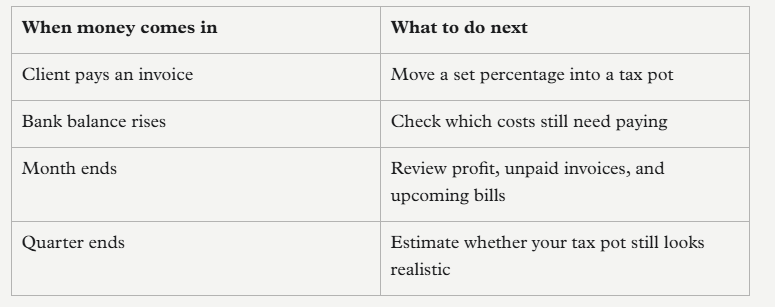
This method stops tax money blending in with spending money. It also makes payments on account less of a shock.
Payments on account catch many new sole traders by surprise. If your Self Assessment tax bill reaches the relevant threshold, HMRC may ask you to make advance payments towards the next year’s bill. These are usually due in January and July. The first time this happens, the January payment can feel larger than expected because it may include the balancing payment for the previous year and the first payment on account for the next year.
That is why early planning helps. A tax pot gives you breathing room when deadlines arrive.
You should also keep an eye on VAT. You must register for VAT if your taxable turnover passes the VAT registration threshold set by HMRC. You can sometimes register voluntarily before that point, but it needs thought. VAT can affect pricing, admin, and how customers view your costs.
If your sales are growing, check your rolling turnover regularly rather than waiting until the tax year ends. VAT registration is based on taxable turnover over a rolling period, not simply your profit or your year-end accounts.
Stay ahead of deadlines and digital rules
Accountancy becomes easier when deadlines are visible. Waiting for reminders from HMRC is a risky system. Put key dates in your calendar, then add alerts a month before and a week before.
Important dates for many UK sole traders include:
- 5 October after the tax year you started trading Deadline to register for Self Assessment if you have not already done so
- 31 January Online Self Assessment tax return deadline and payment deadline for tax owed
- 31 July Second payment on account deadline, if this applies
- VAT return dates These vary depending on your VAT periods
The UK tax year runs from 6 April to 5 April. That means records for the tax year ending 5 April are usually reported by the following 31 January if you file online.
Making Tax Digital rules are also being phased in for income tax. The details and thresholds can change, so check HMRC guidance or ask an accountant whether the rules apply to you. Even if you are not yet required to keep digital records, getting comfortable with digital bookkeeping now can make later changes easier.
Good accounting software can help you:
- Send invoices
- Record expenses
- Capture receipts
- Reconcile bank transactions
- Track profit during the year
- Prepare figures for your tax return
Still, software does not replace judgement. You need to categorise costs properly, check imported transactions, and understand what the reports mean. A clean system gives better information, but only if you maintain it.
If you work with an accountant, do not wait until the deadline to send everything over. Accountants are busiest near Self Assessment deadlines, and rushed work increases the chance of missing something. Sharing records earlier gives time to ask questions, correct gaps, and plan for the bill.
Review the numbers before they become a problem
Bookkeeping tells you what happened. Accountancy should also help you decide what to do next.
Set aside time once a month to look at the basics:
- How much income came in?
- Which invoices are still unpaid?
- What did you spend most on?
- Did profit improve or fall?
- Is the tax pot on track?
- Are prices covering time, costs, and tax?
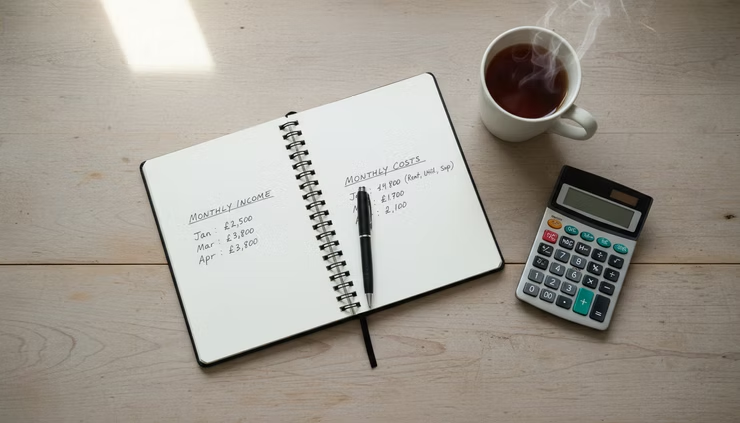
This does not need to become a full financial review with complex charts. A simple monthly check can spot issues early. If income is strong but cash feels tight, unpaid invoices may be the problem. If sales are steady but profit is falling, costs may have crept up. If work is busy but earnings are low, pricing may need attention.
Cash flow deserves special attention. A sole trader can be profitable on paper and still struggle if customers pay late. Clear invoice terms help. So does sending invoices promptly and following up politely but firmly.
A good invoice should include:
- Your name and trading name, if you use one
- Your contact details
- The customer’s details
- A clear invoice number
- The invoice date
- A description of the goods or services
- The amount due
- Payment terms
- Your bank details
- VAT details, if registered
Number invoices in order and keep copies. Gaps in invoice numbers can cause confusion later, even if there is an innocent reason.
It also helps to review your prices at least once a year. Sole traders often absorb rising costs for too long. Insurance, materials, software, fuel, rent, and utilities can all increase. If prices stay frozen while costs rise, profit shrinks.
Your accounts are not just for HMRC. They are a guide to whether the business is giving you the income, stability, and time you expected.
Know when to get help
Many sole traders handle basic bookkeeping themselves, especially in the early days. That can work well if the business is simple and records are kept up to date.
There are times when professional help can pay for itself in saved time, fewer mistakes, and better planning. An accountant may be useful if:
- You are newly self-employed and unsure how to register
- You have fallen behind with records
- You are approaching the VAT threshold
- You employ someone or plan to
- You buy expensive equipment for the business
- You work from home and want to claim costs correctly
- You have income from more than one source
- You are considering moving from sole trader to limited company
- You have received a letter from HMRC that you do not understand
You do not have to hand over everything. Some sole traders do their own bookkeeping but ask an accountant to review the figures and prepare the tax return. Others use an accountant for planning and advice, then keep day-to-day records themselves.
The best arrangement is clear. Agree who does what, when records should be shared, and what format they should be in. If your accountant asks for digital records, receipt images, or reconciled bank transactions, build that into your monthly routine.
Good accountancy support should leave you feeling clearer, not more confused. You should understand your tax position, your deadlines, and the main numbers that drive the business.
The simplest system is the one you keep using
Sole trader accountancy does not need to be perfect to be useful. It needs to be consistent.
Start with the basics: separate your money, record transactions weekly, keep evidence, save for tax, and review the numbers each month. Those habits reduce stress and help you make better decisions before problems grow.
If your current system is messy, do not wait for a quiet month that may never arrive. Open a separate account, choose a record-keeping method, and set a weekly reminder. Small steps taken regularly will do more for your finances than a once-a-year scramble through receipts.